
The Two Directions: Chur to Tirano vs. Tirano to Chur
The Bernina Express runs between Chur (or St. Moritz) in Switzerland and Tirano in northern Italy, crossing the Rhaetian Railway — a UNESCO World Heritage route. Most travelers ask the same question before booking: does it matter which direction you travel? The short answer is yes, and the difference is more meaningful than you might expect.
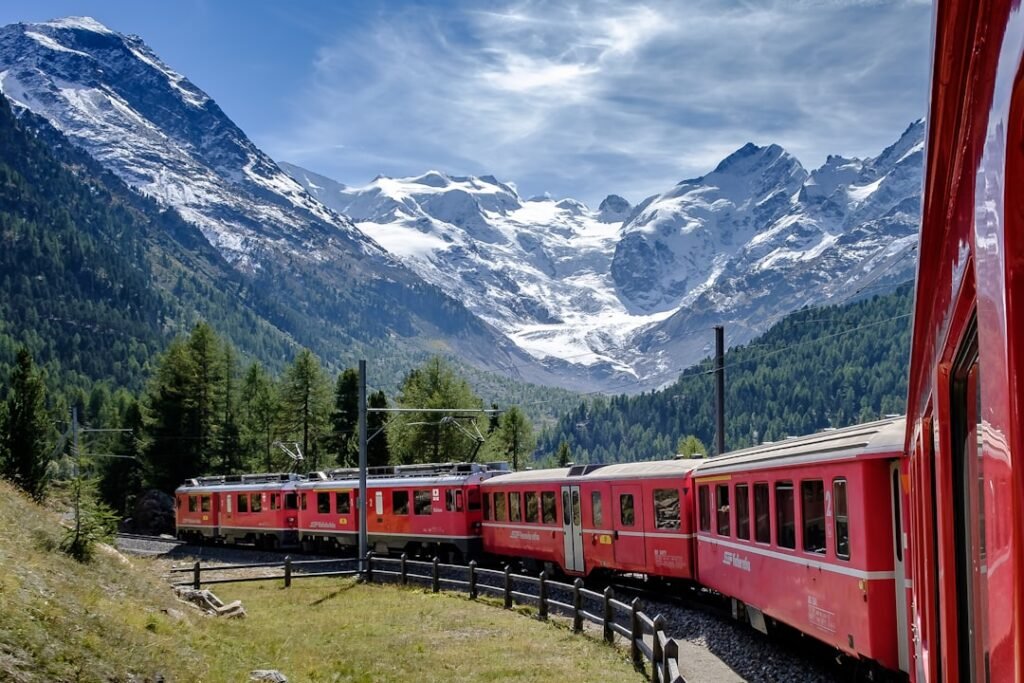
Traveling from Chur or St. Moritz southward toward Tirano puts you on the left side of the train for the most dramatic views. This direction takes you downhill through the Alps, meaning you get a front-row perspective of the famous Brusio Spiral Viaduct — a circular stone bridge that loops the train around itself to manage the steep descent. Sitting on the right side heading south means you will largely see the rock face rather than the open valley below. Book a left-side window seat in advance if you are heading south.
Heading north from Tirano to Chur or St. Moritz gives you a more gradual climb, with the landscape opening up slowly as you gain altitude. The Morteratsch Glacier comes into sharp focus on this route, and many photographers prefer the northbound light in the afternoon. Right-side seats on the northbound journey align better with glacier views near Pontresina.
If you are starting your trip from Italy, the Bernina Red Train day trip from Milan is one of the most practical ways to cover the full route without overnight stays, giving you the full southbound-to-northbound experience in a single day.
The Most Scenic Stretch: What to Prioritize
No matter which direction you travel, the section between St. Moritz and Tirano is widely considered the visual highlight of the entire journey. This 61-kilometer segment climbs to the Bernina Pass at 2,253 meters — the highest point on any non-rack Alpine railway in Europe — before descending into the Italian valley of Valtellina.
The Lago Bianco, a pair of reservoirs sitting at the top of the pass, reflects the surrounding peaks on calm days and looks almost surreal in early morning light. Just below, the Alp Grüm station offers a panoramic terrace where travelers can step off and take in an unobstructed view down toward Poschiavo. The train stops here briefly, so move quickly if you want a photo.
The Brusio Spiral Viaduct near the Italian border is the single most photographed moment on the entire line. To see it properly, passengers heading south should sit on the left, and those heading north should move to the observation car or stand briefly in the corridor as the train loops around the stone arches.
For a more tailored experience with a guide who can point out key landmarks in real time, a Bernina Train private tour from Milan or St. Moritz gives you the flexibility to pause at the best viewpoints and avoid the guesswork of navigating the route on your own.
If you want to extend the Alpine rail experience beyond the Bernina line, the Swiss Alps train tour from Zurich with the Glacier Express pairs naturally with the Bernina route for a multi-day journey through some of the most spectacular mountain scenery in Europe. Together, they cover an enormous cross-section of the Swiss Alps by rail, each line offering a distinctly different character.
Practically speaking, travel in late May through early October for the clearest skies and accessible mountain passes. Winter trips between January and March offer snow-covered landscapes and fewer crowds, but some high-altitude sections can limit visibility on overcast days. Morning departures generally reward you with better light on the mountain faces.