
The Bernina Express Route: From St. Moritz to Tirano
The Bernina Express runs through the southeastern corner of Switzerland, specifically through the canton of Graubünden. The train operates on the Rhaetian Railway line, connecting St. Moritz in Switzerland to Tirano in northern Italy. The Swiss portion of the route is the star of the show, climbing through the Upper Engadine valley, crossing the Bernina Pass at 2,253 meters above sea level, and descending through the dramatic Poschiavo valley before crossing the Italian border.
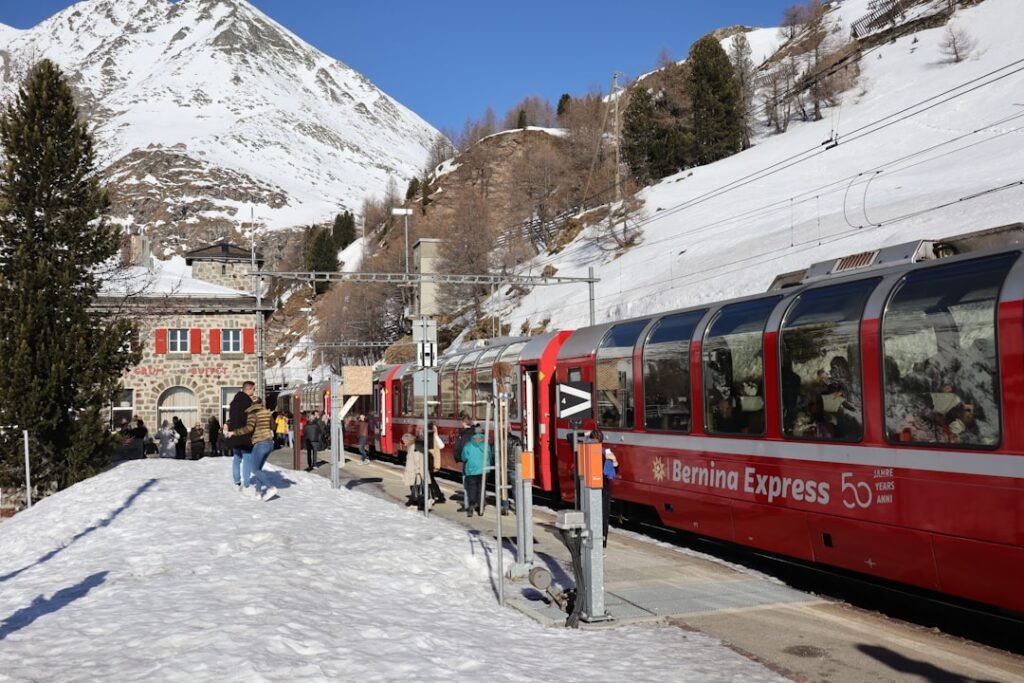
The key Swiss stops along the route include St. Moritz, Pontresina, Morteratsch, Diavolezza, Ospizio Bernina, and Poschiavo. Ospizio Bernina is the highest point on the entire journey and sits right at the Bernina Pass. On clear days, the panoramic views from this station stretch across glaciers, frozen lakes, and jagged peaks that define the central Alps.
The train itself is a narrow-gauge railway, and its tracks are a UNESCO World Heritage Site. The engineering alone is worth the trip. The Brusio spiral viaduct, just before the Italian border, is one of the most photographed railway structures in Europe. The train loops around itself in a full circle to lose elevation gradually across the terraced landscape.
If you are approaching from Italy, a popular option is the Bernina Red Train day trip from Milan, which lets you board in Milan and ride up through the Alps and back in a single day. It is one of the most efficient ways to experience the full Swiss alpine scenery without an overnight stay.
Getting to the Bernina Express and Practical Travel Tips
St. Moritz is the northern starting point for most travelers taking the Bernina Express. You can reach St. Moritz by train from Zurich in around three hours via Chur, where you connect to the Rhaetian Railway. From there, the Bernina Express takes roughly two and a half hours to reach Tirano in Italy, though the full scenic experience makes it feel much shorter.
Seat reservations are mandatory on the Bernina Express, even if you hold a Swiss Travel Pass or Eurail Pass. Book seats well in advance during summer months, particularly July and August, when the train fills up fast. Panoramic car seats are worth the small extra cost. The windows are larger and curve slightly upward, giving you unobstructed views of the glaciers above.
The best seats for glacier views are on the right side of the train when traveling from St. Moritz toward Tirano. For valley and village views on the descent into Poschiavo, the left side offers better angles. Bring a light jacket regardless of the season. Even in summer, the Bernina Pass section can be cold, and the train stops briefly at Ospizio Bernina.
Travelers looking for a more personalized experience can explore a Bernina Train private tour from Milan or St. Moritz, which gives you flexibility over timing and stops. For those interested in pairing the Bernina with another iconic Swiss rail route, the Swiss Alps train tour from Zurich with the Glacier Express is a natural combination that covers some of the most spectacular mountain scenery in Europe.
Most travelers complete the route one way and return by Bernina Express bus or by connecting trains through Italy. The PostBus from Tirano to Lugano is a scenic alternative return route through the Swiss canton of Ticino, adding even more variety to a multi-day Swiss rail itinerary.